
(Links marked with a star correspond to lessons in the Portuguese only Data Visualization course accessible to subscribers. Portuguese only.)
In my course, I call data visualization a "Spanish inn", a place that accommodates the most diverse ways of treating data visually. Some of these approaches fall into what we traditionally consider creativity: more of an aesthetic experience than a way to communicate information. If we open a statistics book, we will likely find the opposite perspective. We find multiple gradients in between.
And what about us, mere mortals, with limited graphic design skills, no tools beyond Excel and Power BI, and whose goal is to monitor sales as effectively as possible? Is there room for creativity in our daily routines?
A different kind of creativity
Of course there is, but not in the form of canned effects or decorative 3D. The "wow!" factor must come from knowledge and the ease of access and interpretation. Being creative here means, above all, being curious ⭐; constantly questioning if there are other ways (more effective, more efficient, more appealing, more...) to communicate that message, rather than being stuck with presets and chart libraries.
But sometimes we fall too much in love with the visual aspect. We forget that, simultaneously, we must torture the data ⭐, looking at it from a distance or through a magnifying glass, alone and cross-referenced with others, comparing linear time with cyclical time ⭐. It’s like a Rubik's Cube: a constant search until we find the alignment that matches our message and resonates with the audience. And then, we start again.
Naturally, this comes at a cost. Perhaps the way it has always been done is the best way to do it. Perhaps the organization is still stuck in 1980. Perhaps the benefits don't justify the disruption. Perhaps the audience lacks the necessary literacy. Perhaps there is a lack of a culture of risk and innovation. All of this is wrapped in the need to navigate office politics, because selling your ideas is essential.
What is my real, real question for the data?
The first step toward creativity is to set aside the data and ready-to-use charts for a moment and, armed only with our doubts, try to understand what our questions ⭐ actually are and the answers we want to find (not regarding the content itself, but the most effective way to answer them).
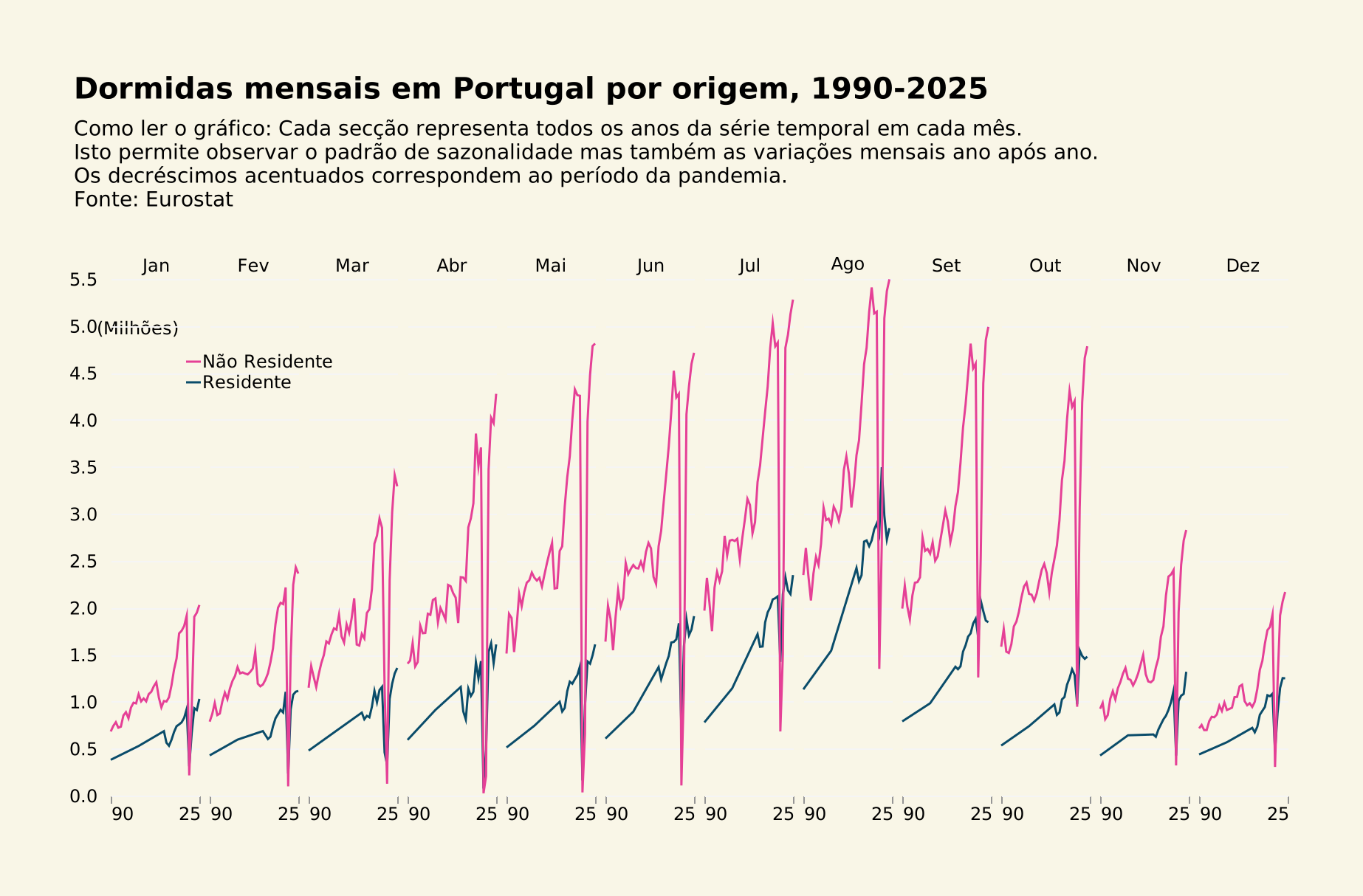
Linear time and cyclical time illustrate this idea well. In charts where strong seasonality is present, a linear representation of time merely tells us there is a summer and a winter. In this chart, on the contrary, seasonality is also visible, but it provides much more local insights into the evolution of tourism. For example, residents tend to take their holidays later and return earlier than non-residents (notice the difference between them in September and October). It is likely that many of these details would be lost in linear time.
(These figures were updated on September 28, 2025, with data up to July.)
Takeaways
Creativity in data visualization doesn't have to result in a purely aesthetic outcome: it should also express new ways of representing data that align with the audience's questions. Clarifying the question makes the type of answer we seek much clearer, without the need to "dump" all the data into a chart and search for the answer there.
